

Apologia
Where I've been.

How are you? I’ve missed you, dear readers! Over the past several months I’ve written nearly bupkis in this space. I’d come to count on these Substack posts as a way to reach out from my deepest depths (and, sometimes, my highest highs). Then, after I recovered from my latest long bout of depression, something weird happened: though I was feeling so much better, I lost confidence that I had anything to say.
I’m living in two places right now: Depression-Town and Normal-Ville. Throughout most of my adult life, I would sink into a deep depression for months at a stretch, then eventually snap back to normal for an extended period — sometimes over a decade. Now, for the first time, something different is happening: I’m vibrating back and forth across depression’s border.
When I was stuck in the depths (most recently, for seven-plus months until sometime last July), I’d look back at my undepressed self as if remembering a different person: someone whose moods and behavior seemed almost inconceivable. I’d wonder, Who was that guy? Mostly, I’d view Undepressed Me as being vastly superior to Depressed Me — someone relatively stable, who woke up ready to face each day as it came. Someone resilient. Whereas Depressed Me woke up each day with dread gnawing at my stomach, with a cold-feeling heart — and, most of all, with a nearly irresistible desire to be unconscious again. The bed beckoned constantly.
Although I have to say that once I started writing to you about my depression, in these (too-)occasional posts, I noticed a rawness in my writing — a realness — that I found refreshing. I wasn’t trying to be clever, or to impress: I was just trying to survive, and connect. And I’d see my undepressed self not just as as my more-favored doppelganger but as … well, kind of glib. I said to my therapist once, when I was in the dumps: “When I come back, I hope I can still stay in touch with who I am now.” It was kind of a shock to hear myself say that, as when I’m in my depressed state I’m desperate to be released back to the usual me. Perhaps I wanted to believe that there was some meaning — some purpose — to my recurrent depressions. That some deep wisdom would result from those visits to the Dark Place.
When I returned to my normal self, last summer, I looked back at Depressed Me mostly with a great deal of empathy. That poor guy! And I shared with you my giddy joy at being released from that terrible, timeless-feeling state — that near-zombie-ness. But then something strange happened: I lost contact with my deeper, more private self. Or at least I found that I’d lost the capacity to describe my inner experiences to you with the same intimacy as before. In a sense, I lost my connection to you. And whenever I tried to write a new Substack post, it felt … well, glib. So I abandoned it.

I aim to write at least one post a week, but months started passing by. It was a weird double life, because at the same time I felt both ecstatic not to be depressed anymore but also kind of numb — at least in terms of my writing. By that point I’d returned to performing, and I was doing weekly improvs toward a new monologue called What Is To Be Done?: Fighting Fascism and Depression — a piece that drew heavily on my experiences writing Substacks from both my own personal hell but also from the political hell we all were (and are) experiencing together. Your kind responses gave me the courage to try to step in front of audiences again. In fact, my recovery from that last depression occurred between my second and third live performances of that improv.
But as I connected with live audiences again, somehow I drifted away from my readers. I have to imagine you as I write, whereas of course the theater audience is right there, in the flesh. Perhaps because there’s that delayed connection in Substacking, and not instant feedback, it makes me spill out my thoughts without knowing whether my experiences will resonate with anyone — which, it turns out, can be freeing.
Anyhow, for whatever reasons, I stopped posting here, for what stretched out into a very long time. I’m really sorry for that!
And then, sometime since the start of this year, I began having these periodic experiences at random times of the day: I could feel my emotional floor begin to melt away. And I could sense the possibility of descending, once more, into the abyss. But then I’d snap out of it.
This scared the shit out of me. I called my psychiatrist at Kaiser, and he told me to up my meds. Which I did.
But the episodes kept occurring. It’s as if I’d been in a spinning carnival ride where I was pinned to the wall by centrifugal force, even as the floor dropped away — but then the spinning slowed to a crawl, so that I almost slipped down from the wall.
Then these mood-drops began happening more frequently, and for longer stretches: whole days of down-ness, instead of just minutes. And the depths kept getting deeper — from momentary discomfort to epic feelings of impending doom. Two days up, two days down: it was like that.
Sometimes these vertiginous experiences took up not whole days, but just parts: at (say) 3 in the afternoon I’d suddenly feel the bottom drop out. But it could go the other way too: at (say) 7:30 p.m. I’d feel a rush of joy, of relief, of up-ness lifting me back to the surface — and I’d feel myself again, gloriously free of depression.
Then, a few weeks ago, I experienced something I never had before: I was just about to do a live performance, when in an instant I felt depression wash over me. I usually love to perform — telling my stories to live audiences makes me wildly happy. But now I had to go onstage in a suddenly very depressed state. It was terrifying and strange. Also, I use up a lot of energy when I perform, and depression saps me of energy and strength. So now I took the stage, before a lovely, warm audience, in a beautiful theater, feeling — for the first time in my career — like Depressed Me internally while outwardly I seemed (from what everyone told me afterwards) totally normal. It was as if I was this miserable person inhabiting the body of someone who was cheerful and competent.
One of my thoughts was: Oh, so now I see why so many people are freaked out by speaking before audiences of strangers. Whereas for decades that had been my happy place.
When I was little, I loved a cartoon called Gigantor. Gigantor was a giant robot operated by a little boy who held a controller.
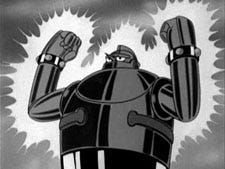
One night I dreamed that I was in charge of Gigantor, expertly controlling him as he destroyed scores of bad guys.

Then I woke up. I was devastated that this incredibly gratifying dream had ended; I wanted to go back. And, miraculously, I did: I made myself return to sleep, and my dream picked up again from where it had left off. When I finally awoke, I had the sense that I had completed the story. I felt fulfilled, whole.

In the theater on that recent occasion, I was somehow controlling my performative self, even as my inner self trembled and tried not to melt down.
What does it mean that I could exist in both states simultaneously? Even afterwards, as I greeted the departing audience in the lobby, I was kind of in shock.
It still amazes me that this happened: joyful storyteller on the outside, mental-health crisis on the inside. A double life.
And yet I swear to you that the ebullient performance was not a lie: it was no less real than the quaking person inside my brain, hoping desperately that my outer self would somehow keep going till the end. In fact, it strikes me now that my outer, performative self was, if anything, more real — that the depression I was experiencing internally was actually distorting reality, telling me I was miserable and weak while the performer stayed confident and strong.
Since then, I’ve metabolized into an unsettled state. My mood goes way up and way down — sometimes for days, sometimes only for hours. Usually the depression lasts much longer and the relief is relatively brief.
But wow, I cherish those short periods of normalcy. And I am learning to fight for them.
I have been working on a new kind of practice: trying to will myself, to imagine myself into a better mood. I’ll wake up miserable, and have the hardest time getting out of bed. But I’ll be visualizing being free from the depression. Coffee, breakfast, and I might feel just the tendrils of a mood-lift. When that happens, I try to nurture those tendrils — to take the idea of relief and turn it into a reality. Not by much! Usually, when I do experience a lift, it’s incremental. But in my new practice I’m training myself: When I feel that I’ve climbed up a rung, towards the light, I do my darnedest to acknowledge the progress I’ve made. And I visualize climbing up yet another rung. Eventually, over the course of hours, after making it up several rungs, I can sometimes feel kind of like my normal self (though with the knowledge that this relief is almost certainly temporary).

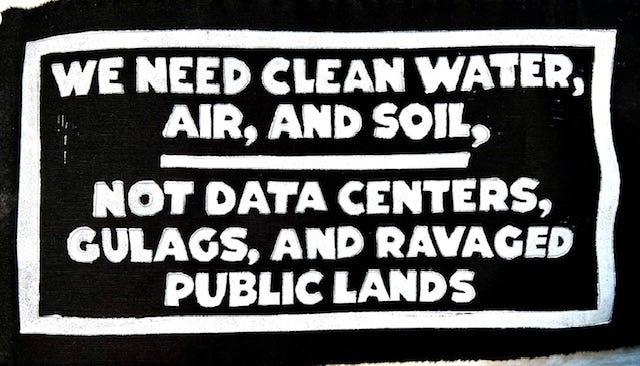
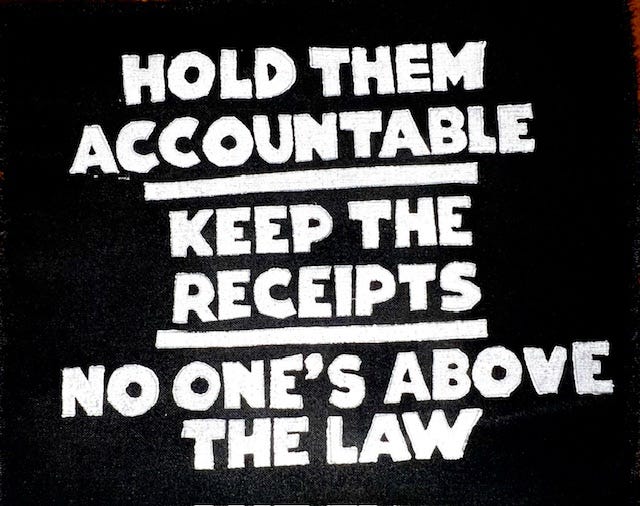
There are also times when I’m deep down in the depths but I can look out, with my mind’s eye, and see that the world outside my miserable self is filled with beauty. That it’s the beauty that’s real. Similarly, I find myself reminded — especially at protests where I give out patches with Sara — that the fascists and their appeasers are working to manufacture the mass delusion that fascism, hatred, despair are normal. I can’t let my depression define me, nor the authoritarians define my country.
We are living inside a nightmare that is itself inside (and obscuring) so much gloriousness! We need to keep imagining a world of democracy and love and kindness, even as such thoughts are contradicted by virtually everything we see and hear from the powers that be.
I got from my father that people naturally love other people — and that it’s the systems humans have created that manufacture the illusion of Us and Them. Thus we need to develop new systems in which love has the best chances of flourishing.
Though I am no longer so sure that love is the human default, I’m still pretty confident that this is at least true for most of us, most of the time. I am terrified of losing my mind, of losing control, of losing contact with joy and beauty. But my recent experiences have taught me that, perhaps improbably, no matter how I may feel, the real me — the default me — remains astonished and delighted at the blessings of being alive, and of being given the opportunity to relieve the suffering of others.

In my current, unsettled state, I assert that we are connected far more than we are estranged. That our fleeting lives are meaningful, and purposeful. That we can keep imagining the higher rungs, and reach for them, and pull ourselves up. That we cannot, and will not, be pitted against one another. That ultimately, what’s real — or at least what’s realest — is love. And that, no matter how much we may be despairing at any moment, we must keep performing our loving selves, which are our actual selves.
I am so glad to be back with you again.
Thank you for coming back with so much to say. It helps everyone get through the mess we are living in right now. I mean it would be crazy not to be depressed wouldn't it?
One thought that sustains me, along with morning coffee, is that we will dance on ruins of MAGA. It's looking good, Orban lost today, right?
Josh this is really really something, what you wrote. I’m so glad you’re back!