

People in Motion

There was a teenaged boy named Jamey whom my dad took under his wing when I was a little kid. Jamey was rail-thin and pimply, with a long, red face, and lived upstairs from us in our tenement building. I don’t remember ever seeing him smile. I never met his parents — don’t even know if he lived with them. It was all very vague — which was of a piece with so many other things in our lives! The neighborhood, the Lower East Side of Manhattan, was extremely poor. Nearby, both the Con Ed power station and the mysterious tall buildings of the projects loomed over us. Kids were always playing in the street: stickball, stoop ball, jacks, marbles, tag (“You’re it!”). (I was bad at all of these games, but not for lack of enthusiasm.) Then there was the action on the roofs and fire escapes, where youths would wage fierce aerial battle with homemade “fighter kites” (you fashioned them out of notebook paper, usually, then coated the string — first with Elmer’s glue, then with glass shards; the goal was to have the last kite with its string still intact). On the corner was the candy store — but at some point it came to have less and less candy for sale … and yet people (including lots of teenagers) were still going into the back to buy some non-candy stuff.
“They’re dealing heroin,” Dad explained to me. “It’s so sad!”
All of this was a delirious blur to me. In my mind East 7th Street, between Avenues C and D, was a heavenly chaos. One in which I — as a chubby, nerdy communist kid — didn’t exactly fit in. But oh, I tried!
Dad had gotten me a bike, with training wheels. Excitedly, I took it out for a spin. Right away, a neighborhood kid came up to me, regarding my shiny new bike, and said, “Can I see it?” He was speaking in an ambiguous code: “Can I see it?” could mean either “Can I borrow it?” or “Can I take it away from you forever?” — and it was sometimes impossible to tell what the intent really was. But you generally (if you were me) didn’t want to say, “No.” For one thing, you wanted more than anything to be popular and accepted; for another, you didn’t want to get knocked down. So there were these nuanced considerations. Anyhow, I let him look at my bike, and this time he brought it back.
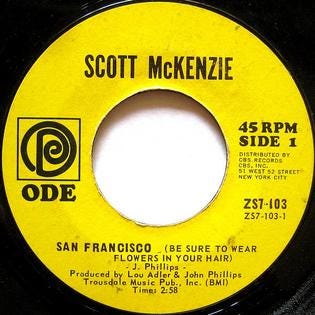
As much as I sought the approval of my fellow kids, I really looked up to Jamey. A teenager, taking an interest in me! On my eighth birthday, in 1967, Dad gave me my first record player — a little thing, made mostly of plastic — along with my first-ever record: a single of Scott McKenzie’s “San Francisco (Be Sure to Wear Flowers in Your Hair),” which had just come out. Once, when Jamey was visiting, I proudly played my record for him — and he loved it! I watched him nod along to the sweet, hopeful lyrics:
If you’re going to San Francisco
Be sure to wear some flowers in your hair
If you’re going to San Francisco
You’re gonna meet some gentle people there
His eyes, normally squinting with some private unhappiness, opened wide and seemed to be looking all the way across the country, to this impossible, peaceful, gentle place, so different from East Seventh Street’s Hobbesian clamor. When the record was done, Jamey asked me to play the song again. And again. And again.
On one of the re-listenings, I began focusing on the words of the song’s bridge:
All across the nation
Such a strange vibration
People in motion
There's a whole generation
With a new explanation
People in motion
People in motion
I marveled at the gentle, vibrating people in motion who, according to the song, populated far-off San Francisco. Jamey was almost smiling. I wondered whether he was thinking the same thing.
Finally, on his way out, indicating the record player, Jamey said, “Can I see it?”
I said, “Sure!” And he took it and the single upstairs.
I was beside myself with joy that Jamey had deigned to borrow my record player, and that he and I were grooving to the same cool song. I was a tastemaker!
The next day, Sunday, Dad took the training wheels off of my bicycle. “You’re ready, my son!” Jamey offered to teach me how to ride my (now) two-wheeled bike. Again, I was thrilled that he was taking this interest in me.
Out on the sidewalk, Jamey firmly held the back of the seat while I tremulously got on.
“I’ve got you, Joshy!” he whispered in my ear. “Just start pedaling.”
As I turned the pedals, I could feel Jamey still holding on behind me — and then, suddenly, he wasn’t! I was propelling myself down the block, somehow balancing on two wheels all by myself. It was exhilarating! Then, as I built up speed, it occurred to me that I had no idea how to stop. I ended up plowing into an elderly woman who was standing, with her shopping cart, in front of the candy store. Quite understandably, the woman was peeved at me, but my own feelings were mixed: embarrassed, sure, but also still feeling the rush of having conquered non-training-wheel bike-riding (at least the pedaling-forward part).
Later that day I was still on a high from the weekend’s events as I hung out on our front stoop, in my usual position of observing all the rapidly moving kids on our block, playing and fighting and laughing and cursing. Then I heard a sound that conveyed pure joy: The ice-cream truck, blaring its catchy jingle, was coming around the corner from Avenue D! I ran inside to our apartment and asked Dad for some money for ice cream, then dashed back out onto the sidewalk and then into the street, fixated on getting to the ice-cream truck, which was parked on the other side.
And just then a car came racing around that same corner and zipped past me on the street — so close that I could feel one of its door handles rub against my tummy. The car scooted away, and, trembling and scared, I made my way back to the apartment, where I told my dad what had just happened.
He was horrified, of course — and immediately announced that he was going to start a petition to get a stoplight installed on our corner. “We poor people deserve safety, too!” (He eventually would gather a whole lot of signatures from folks on our block. In the end, we didn’t get a stoplight, but the city did put up a sign telling drivers to be cautious because children were playing.) The whole rest of the day, I remained intensely shook up by the experience — what a dangerous world we lived in!
In the late afternoon, I thought it would be lovely and relaxing to listen to my record of “San Francisco (Be Sure to Wear Flowers in Your Hair).” Dad said he’d go upstairs and get my record player back from Jamey. When he returned, he had the record player, but he was incredibly agitated.
“What’s wrong?” I asked.
Dad sighed. “Look, my son — Jamey scraped off the serial number!”
I didn’t know what this signified.
Dad said, “When you’re a heroin addict, all you want is money for your next fix. Jamey was going to sell your record player to someone else so he’d have drug money.”
I was stunned! How could my teenage pal Jamey do something so awful to me?
Dad said, “This is what capitalism does to people.” Then he said, “Jamey can’t come over anymore.”
I began to cry, and Dad comforted me. “One day we’ll have a revolution, and no one will need to steal, or fight, or hate. You’ll see: The American people can spend the longest time seemingly going nowhere, but then suddenly, when they do move, they stride with seven-league boots!”
As I look back through the decades at that tumultuous weekend, struggling now with depression and the side effects of various meds and facing an intensely scary world from my vantage point in the San Francisco Bay Area (no flowers in my hair; then again, not much hair, either), I find enormous comfort in my father’s words.
Performance note: Improvs of my show What Is To Be Done?: Fighting Fascism and Depression resume this Friday at 7:30 p.m. Click here for tix & info.
Somehow you managed to transport me to a place and time I never knew but now feel intimately familar with it. How do you do that, Josh?
Beautifully written story! Thank you!